mercoledì 19 febbraio 2020

Ed's Corner: Beyond the image, journey through the hidden meaning of movies - Twin Peaks

L'appuntamento con Edoardo e le sue digressioni filmiche tocca oggi il suo apice con quello che per me è il capolavoro di David Lynch: Twin Peaks. Si parlerà delle prime due stagioni, di Fuoco cammina con me e della serie evento che abbiamo coperto anche io e Alessandra, anche se non in maniera così seria e competente. Altro non dico se non "buona lettura"! ENJOY!

Dear readers, even if I think Lost is the best TV series ever made so far, it is nothing revolutionary.
The reason is simple, the revolution had started many years ago, in 1990, with this immortal masterpiece: Twin Peaks by David Lynch, written with the screenwriter Mark Frost.
It was truly a tv revolution, because all the series that came later have taken from it: Lost, The Sopranos, Black Mirror, Fargo, X-Files, Breaking Bad, Stranger Things, just to list some.
Twin Peaks was released in 1990, and since the beginning it was a major success, even the title soundtrack became a cult. Of course it’s easy to turn a title song into a cult when it’s written by the same genius who wrote the whole soundtrack, and who followed Lynch along all his career: Angelo Badalamenti (to be clear, he is the one that spits the coffee on the napkin in Mulholland Drive).
Related to that, I’ll add below the link to the video on how Twin Peaks’s soundtrack was born, to make you better understand who I’m talking about and how extraordinary his musical inspiration is: https://www.youtube.com/watch?v=e-eqgr_gn4k.

Let’s talk about the plot, which I advise you to not avoid. Read it carefully, because inside it I put some clarifier elements. If you haven’t seen the series though, stop here with the reading, because there will be spoilers.
Twin Peaks is a fair city in Washington, close to Canada, where one day, by the river (or a lake, I can’t remember) the corpse of a girl is found. Her name is Laura Palmer (Sheryl Lee).


This is the main event of the first two seasons, and all the strange characters and side events revolve around it. First of all, FBI agent Dale Cooper (Kyle MacLachlan), sent to Twin Peaks to investigate the murder.


Then we meet the citizens: Peter “Pete” Martell (who found Laura’s body, played by Jack Nance), Bobby Briggs (Laura’s “boyfriend”, and main suspect, played by Dana Ashbrook), sheriff Truman (Michael Ontkean), waitress Shelly Johnson (Mädchen Amick), Donna Hayward (Lara Flynn Boyle), Laura’s parents, etc, etc, etc, I won’t introduce all of them to you (also because it’ll take me half a day). I can tell you though, every character (or almost every character) is unforgettable due to its own construction and interpretation.
During the investigations Ronette Pulaski, one of Laura’s school friends, is found in a confusional state and precarious health. She’ll shortly go into a coma.
The plot goes on and we meet new characters, and everything relates to the investigation on the murder of Laura Palmer.
The first episode ends with Sarah Palmer (Grace Zabriskie), Laura’s mother, that has a vision of a long-haired man while looking at the mirror.

Starting from the second episode a topic particularly dear to the director begins to unroll, the one of dreams, during a speech that Laura’s best friend Donna gives to her mother: “It's like I'm having the most beautiful dream...and the most terrible nightmare all at once”.
And in the third episode, when Cooper talks of his dream about Tibet, or when, for the first time, close to the end of the episode a dream is shown, where we see a man with a beard that talks in metaphors (his name is MIKE), and another man with long hair. The name of this man is BOB (Frank Silva).

Then an old white-haired Cooper appears, sitting in a room with red curtains, and next to him a dwarf dressed in red and Laura Palmer. The two speak in metaphors, giving him clues on where the girl was murdered.


For the first time we can admire the room with the red curtains and that odd floor, imprinted on everyone’s mind when talking about Twin Peaks.
By the way, that floor, doesn’t it remind you of anything?


The first three episodes were written and directed by David Lynch and Mark Frost.
The events carry on with Laura’s funeral, the arrival of agent Albert Rosenfield (Miguel Ferrer) to help Cooper with the investigation, a small piece of plastic with the letter J written on, found inside Laura’s stomach during the autopsy, the letter found under the nail, the strange doctor Jacoby, Ed who is in love with Norma but married to Nadine, Andy and Lucy, Laura’s cousin (Maddy Ferguson) which looks exactly like her, she falling in love with James Hurley (Laura’s lover), the fake bills of Catherine Martell’s sawmill, the one-armed man (who we’ll find to be MIKE), Leo Johnson’s (Shelly’s violent husband) shirt with blood stains, the One Eyed Jack’s and the shady Jacques Renault (suspected of Laura’s murder), Norma’s husband that gets out of jail and doesn’t seem to have changed, Log Lady that has strange premonitions, Audrey Horne that get hired at the One Eyed Jack’s to investigate on the murder …
Those are the events depicted on episodes 4 – 5 – 6 – 7 (it’s very reductive to say that, but it simplify things for me), episodes written and directed by first time directors, but still following the main line setup by the two creators of the series.
In the last episode of the season (directed by Mark Frost), Jacques Renault gets arrested by the police (Andy shoots him), and whilst in hospital, Leland Palmer (Laura’s father) suffocates him with a pillow. In the meanwhile Leo Johnson ties his wife to the sawmill to get revenge from her cheating and set the building on fire. In the ending a mysterious person shoots agent Cooper.

This first season was an absolute success, in USA and abroad. A success where every kind of cinematographic genre is combined together: from horror, to comedy, to soap opera, to mystery, to detective, to thriller, to demential comedy, to weird, in a terrific technique exercise. As to say: “I can do whatever I want”.
And to better explain the quality of the series, I’ll tell you a curious episode: the first season was over, USA and Russia (ex Soviet Union) had ended Cold War and started commercial exchanges, including tv shows and films, this series too.
The Russian president at that time was Michail Gorbachev, he got so stunned by the series that he wanted to know who killed Laura Palmer.
So he decided to phone call the new USA president George Bush to ask him about Laura’s killer. Bush answered that he didn’t know anything about that, but because he was a huge fan of the series too, he decided they had to find out. So he called Carl Lindner, who bought half of Aaron Spelling Production; but Linder didn’t know either, and called Aaron Spelling, the founder; but he didn’t know who killed Laura Palmer, and called Jules Haimovitz, the main promoter of the series; however he was not aware of that, so he called David Lynch directly, telling him about the situation. But, despite all the bustle, Lynch didn’t say anything to him.
“I don’t care if it’s a big deal. I can’t tell who killed Laura Palmer” was the answer.

Let’s talk about the second season. The first episode starts with Cooper having a vision (or dream) while he is lying on the floor, wounded by a gunshot. A giant appears to him, and tells him three clues: “There’s a man… in a smiling bag”, “The owls are not what they seem”, “Without chemicals… he points”. Every clue is going to occur sooner or later during the season (the first one is related to Jacques Renault’s corpse, the second one to BOB and the third one to MIKE). Than another clue comes: "Leo locked inside a hungry horse”, referring to the night when Leo Johnson was locked inside a prison called Hungry Horse, on February 19th 1988, same day when Teresa Bank was killed at Deer Meadow by Laura’s same murderer (the letter under her nail proves that). Ergo, if Leo was in prison he couldn’t have killed the two girls.


So if Leo and Jacques Renault were with Laura and Ronette the night of the murder, but none of them is the murderer, we need to find out who the third man was. The real murderer.

The plot continues: Catherine and Josie Packard disappear in a mysterious way after the fire at the sawmill, Benjamin Horne hires Hank to kill Leo (who goes in a coma), Ronette Pulaski wakes up from the coma and identifies her attacker on one of the drawings shown to her by Cooper, Windom Earle (Cooper’s psychopath ex colleague) escapes from the mental hospital, Donna meets Mrs. Tremond and her nephew Pierre (who seems to have unusual powers), then she meets an agoraphobic boy named Harold Smith. In the meanwhile Audrey Horne gets discovered and taken as hostage at the One Eyed Jack’s by Jacques Renault’s brother: Jean, who wants to kill Cooper (he thinks he’s responsible of his brother’s death). Then Lucy, sheriff Truman’s secretary, finds out she’s pregnant, doctor Jacoby confesses to Cooper that he saw Leland Palmer killing Jacques Renault, Nadine wakes up from the coma and thinks she’s a teenager, Harold Smith holds a secret diary owned by Laura Palmer.
Leland Palmer’s interrogation for Jacques Renault’s murder takes place. Benjamin Horne, forced by Jean Renault, asks Cooper to personally bring Audrey’s ransom money. Josie gets back to Seattle with her cousin Jonathan. Donna gets jealous because of the relationship between James and Maddy and starts seeing Harold Smith.
Cooper manages to save Audrey, but Jean Renault runs away (he’ll get killed later).
Gordon Cole (David Lynch), Cooper’s chief at the FBI, comes to town to bring a paper to Cooper, probably given by Windom Earle, with a chess move written on top, while MIKE speaks to Cooper about BOB, describing him like a demon that feeds on pain and suffering of other living beings.
After a while we discover that major Briggs is working on a secret military project, with the purpose of getting in touch with extraterrestrial living forms (this series is extraordinary: it can mix thriller, detective, then romance, then again horror with a taste of spiritualism and supernatural, then aliens aagain… whenever the viewer thinks he has been given a clear answer, Lynch scrambles things out all over again). The Log Lady takes Cooper to the Roadhouse, where the giant tells him that something terrible is happening again. In fact in that moment Leland Palmer, possessed by BOB, is killing Maddy Ferguson. After discovering Maddy’s death, James Hurley leaves town. Now Cooper, willing to find the murderer, calls everyone around to the Roadhouse, even Leland Palmer, Ben Horne, Leo Johnson, Bobby Briggs and an old waiter of the Great Northern. He revives the first dream (season 1 episode 3), and hears Laura that whispers into his ear the words “my father”.


With an excuse Leland Palmer is taken into a cell, and gets locked inside. It’s time for BOB to appear in front of everyone, and he forces the man to commit suicide, smashing his head against the door. Before dying, Leland sees his daughter Laura again. The mystery is revealed.
Shocked for what just happened, Cooper, Truman, Albert and major Briggs get off the building, and once and for all they clarify BOB’s nature, evil of course.
It’s clear now that there are two mystic places, that bring back to an ancient Native legend: White Lodge and Black Lodge. The room with red curtains is a sort of purgatory, where spirits await before going to the White or Black Lodge. In particular, using simple words, the “good side” of a person will end up to the White Lodge, the “evil side” (doppelganger) to the Black Lodge.

The next day is Leland’s funeral, Josie Packard comes back to Twin Peaks and meets up with sheriff Truman. During the night, while Cooper and major Briggs are in the woods for a walk, the second one disappears mysteriously. This is basically the plot till the 10th episode.
From here on, maybe due to audience drop, the series horribly lowered his quality (the peak gets reached with Windom Earl’s character, so embarrassing). Few events need to be mentioned: Josie’s mysterious interests, the return of Catherine’s brother (who faked his death), Nadine going back to high school, the revelation that Josie was the one who shot Cooper, Josie’s sudden death (where BOB is involved).
The last episode (directed by Lynch) takes the season back on track; Cooper manages to get into the Black Lodge, and there he finds Laura Palmer again (she tells him they’ll meet again in 25 years) and the dwarf (he tells him that when they’ll meet again his appearance will be different). Both premises seem to be designed for the return of this beloved series, exactly 25 years later.
Cooper is trapped into the Black Lodge, and BOB possesses his body (Cooper’s doppelganger, his “evil twin”, escapes, while he gets trapped).
Memorable is the scene where the  doppelganger chases him and finally catches him. A tribute to the masterpiece Kill, Baby, Kill! by the great Mario Bava. Chasing ourselves.
At the same time Pete Martell gets killed by an explosion in the bank where he came with his brother in law to do a cash out, and Audrey Horne (who chained herself there as a protest), gets into a coma. The episode ends with Cooper that hits the mirror with the head, and sees BOB sneering in the reflection.


At the end of the season, ABC shut down the series, due to audience drop. The beginning of the Gulf War focused the audience towards the news (also due to the fact that Laura Palmer’s killer was revealed too soon), and even if the last episode was a success, it wasn’t enough to renew the contract. Despite so, Twin Peaks had become already a worldwide cult, destined to remain in people’s mind.
Even The Simpsons, which to me is “the greatest creation ever appeared on screen”, tributes this piece of art twice.

That's damn fine coffee you have here in Twin Peaks...
Burn's suit


Fire, Walk with Me

“Through the darkness of future’s past, the magician longs to see. One chants out between two worlds. Fire, walk with me”.

Here we get to the film, which is actually a prequel, made in 1992, with the purpose of explaining the events before Laura Palmer’s murder. Unlike the series, where Lynch was restricted in expressing his cinema (particularly on the abstract side) because of marketing reasons (the series targeted a very wide audience of different age), this time he can use all his inspiration, and can shoots his own way: weird, dark, metaphoric, deconstructed, wonderful.
Fun fact: the actress Lara Flynn Boyle couldn’t take part at the shooting, because she was working on another film, so Donna Hayward was played by Moira Kelly. I didn’t really appreciate this choice because I’ve always been against changing the actor for a character. It’s like changing his identity.

The film starts at Deer Meadow, where FBI agent Chester Desmond gets called by Gordon Cole in order to investigate around the murder of Teresa Banks.
Soon starts the obsessive symbolism of the film, where the FBI agents meet a dancer, who gives them informations dancing instead of talking. After that scene, agent Desmond explains to his colleague the meaning of that dance, and the reason why the dancer had a blue rose on her dress (this is the first time the blue rose gets nominated).
At the obituary, on the girl’s body is found a little piece of paper with a T letter written on top, under the nail of a hand. Investigation will lead to the caravan field where the girl used to live (handled by Carl, Harry Dean Stanton). Here agent Desmond finds a mysterious green ring, and suddently disappears.

In the meantime in Philadelphia long time missing agent Phillip Jeffries (David Bowie), reappears and tells Gordon Cole and Cooper that he has been in a sort of nightmare for two years. He’s talking about the Black Lodge, where he was trapped in (in fact we see there BOB, the dwarf, Mrs. Tremond and her nephew, all evil spirits of the Black Lodge, while the giant is part of the White Lodge).
Here are many enigmatic scenes too, like Cooper’s image that embeds on the security camera right before Jeffries comes. Or the weird things that Jeffries says: “Well now, I'm not gonna talk about Judy. In fact, we're not gonna talk about Judy at all, we're gonna keep her out of it”.

"Who do you think this is, there?"
Events then go straight to a year later, at Twin Peaks, during the days before Laura Palmer’s murder. The film shows us the girl’s attitude towards her family, her friends, her school friends. She suffers deeply, to the point that she decides to become a prostitute. Her father is the source of her suffering: possessed by BOB, he’s been raping her since she were 12 years old.
One night the girl dreams of being with agent Cooper and the dwarf, inside the Black Lodge. It is now that the dwarf reveals he’s MIKE’s arm, which he cut off by himself as sign of his “conversion” to the good side (on his arm he tattooed the phrase “Fire, walk with me”).
Later on in the film we see that it was Leland Palmer the one who killed Teresa Banks in Washington (always possessed by BOB), who was his lover during his business travels to the city (the girl was an addict that used to sell herself in order to get a dose). The green ring found is a sign left by the spirits of the Black Lodge (in this case Mrs. Tremond and her nephew) to the current victim. So it was for Teresa Banks, so it’ll be for Laura Palmer, killed by her own father, after interrupting an orgy with Leo Johnson, Jacques Renault and Ronette Pulanski (the last one will manage to escape thanks to the help of MIKE).
The girl’s body will be found by Pete Martell (the beginning of Twin Peaks). Laura’s suffering (garmonbozia) will feed the spirits in the Black Lodge.


Relevant in this film is the constant presence of electricity, as it was in the second season of the series (light’s drops of tension, lightnings, electricity noise, etc, etc, etc).


The return

In 2015, Showtime network decides to produce the return of this big project, this time giving to the director maximum freedom.
The result is pure Lynch, is pure cinema, a revolutionary product, one of the best visual manifestations ever made, light years ahead of any other tv series.
This time there are no brakes, episodes are entirely shot by him and he decides what to do, as it’s always been with his films. The only thing that concerned me at the beginning was the early departure of some of the cast, like Frank Silva (BOB), Jack Nance (Peter Martell), David Bowie, or the fact that some actors decided not to take part to this third season, like Michael Ontkean (sheriff Truman) or Laura Flynn Boyle (Donna Hayward), the first one because he had retired from scenes, the second one because of her alcohol addiction. Without mentioning the exclusion of Michael J. Anderson.
Despite so, Lynch fixed those drawbacks in a clever way, using digital effects and introducing new characters, like sheriff Truman’s brother, who take his place while his brother is healing from his disease (it’s clear that the director wants to try to convince him to be in the fourth season, and it would be great if he’ll accept, mostly after having seen the result).
We find almost the totality of the characters left 25 years ago: Cooper trapped in the Black Lodge, where time and space don’t matter (“Is it future? Or is it past?”), while his evil side (his doppelganger) is busy with murders and shady business; the sheriff’s brother who, as said before, has taken his place; vice sheriff Hank, Lucy and Andy (they are married and had a baby), Benjamin Horne and his brother, Log Lady, doctor Jacoby (even more strange than he used to be), Hank, Norma, Sheryll, and so on.
Action is now not limited to the town of Twin Peaks only, but it also involves many other characters and locations, basically the whole world (New York, Las Vegas, Montana, New Mexico, South Dakota, Brazil).
It’s soon clear that the director is trying to give the series a universal dimension, and this includes actors. This time the cast is extremely various, from its glorious names (Laura Dern, Naomi Watts, Harry Dean Stanton, etc…), to James Belushi, Ashley Judd, ex UFC athlete Michael Bisping, Ethan Suplee, Meg Foster, Tim Roth, Jennifer Jason Leigh, and so on, all fans of this extraordinary tv series, all longing to be part of this great return (and I think that for the fourth season they will be even more).
Fun fact: almost all the episodes of the third season end with a gig at the Roadhouse, showing good performances and making an amazing tribute to music, a basic element in all the works of the director.
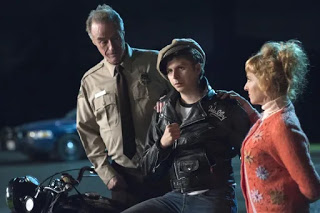
Wonderful tribute to Marlon Brando
The action moves to the city of Buckhorn, in a flat where the head of a librarian, Ruth Davenport, is found on top of the beheaded corpse of an unknown man. Meanwhile in New York a strange experiment is performed: in a room, a young man is paid to watch a glass box; one night a girl comes in with him and they start having sex, while a mysterious entity appears, killing both of them.
In the meantime Cooper’s doppelganger kills some of his business partners, after finding out that an unknown person had ordered them to kill him.

Tomorrow, I'm supposed to be pulled back into what they call the Black Lodge
The real Dale Cooper meets MIKE, Laura Palmer and Leland Palmer at the Black Lodge, and MIKE takes him to the evolution of the arm. On the internet I found many time the use of the term “talking tree”, and I’m really surprised that no one noticed the strong symbolism that is in this figure: it’s not a talking tree, it’s a central nervous system, a brain that through electric impulses controls the body, what looks like branches are nerves. The arm has no power without the brain, it’s only matter, it can’t do evil.


Once again electricity has an important role, and so will be along all the season.
The giant (who introduces himself this time: his name is Fireman) sees everything from the White Lodge, and calls Cooper telling him that he must come back to the world to stop BOB. So he ends up teleported inside the glass box in New York, before the young lovers came into the room and before the appearance of the evil entity. From there he get teleported again into the Black Lodge, where he meets a woman with no eyes (who looks Asian), she protects him from a mysterious entity (great scene this one). Then they both end up in what looks like a Space station, where the woman pulls a lever, releasing an electrical discharge (maybe the electric chair is on).

The electric chair is on
In outer space, Cooper sees the face of major Briggs, who mentions the Blue Rose.


From here, the real Cooper trades places with another doppelganger, Dougie Jones, created by MIKE. So he goes back to the “real world”, while in the Black Lodge the doppelganger will become a little metal sphere.
In the meantime his evil twin gets sick whilst driving a car, than throws up and passes out.

Doesn't it remind you of anything?

The electric chair is on
In Las Vegas, as Dougie, Cooper’s brain is blank, it looks like he lost his memory and the faculty of speaking. A prostitute gives him a lift and leaves him to the casino. Here he plays slot machines, guided by an avatar of the Black Lodge, and wins more than 400,000 dollars. The metaphor for Hell is beautiful.

HELL-ooooooo
Meanwhile in Philadelphia, Gordon Cole receives a phone call: Cooper (Evil Cooper) was arrested in South Dakota; Dougie/Cooper comes back home (he’s married with Janey-E, Naomi Watts), while in Twin Peaks Bobby Briggs (who became vice sheriff) informs Frank Truman that Cooper was the last person to have seen his father before he died in a fire at the station; Gordon Cole and Albert go to see Evil Cooper in jail, and he tells them that he used to work for Phillip Jeffries; Janey-E takes her husband to his office, where it seems like a colleague of him is playing dirty; at the same time some hitmen are trying to kill Dougie, by putting a bomb under his car (Dougie owes them money, and the debt will be paid by his wife).


Mitchum brothers fire the casino’s manager, because they think he’s partner with Cooper; in Twin Peaks Shelly lends some money to her daughter, who spends it to sniff cocaine with her boyfriend; doctor Jacoby owns a show where he talks about conspiracy theories and sells golden shovels; in Buckhorn the beheaded corpse comes out to be major Briggs’s, with Dougie Jones’s ring inside the stomach; Evil Cooper breaks down the electrical system of the prison using a phone; in Buenos Aires an electric device self-destroyes; a dwarf killer receives a parcel with a black mark, containing a picture of Dougie and one of Lorraine. He kills Lorraine but he can’t kill Dougie.
After that, for the very first time it’s shown the face of the person that till now the viewers only knew by name: Diane (Laura Dern).
Cole convinces her to talk to Cooper, and takes her to the prison where he’s locked. When they meet she gets stunned, telling that that guy is not Dale Cooper. After that Evil Cooper blackmails the prison’s manager, and escapes from the place, escorted by Ray, an ex henchman of his that was ordered to kill him.

Those the events in a nut shell, till the 8th episode, when the series reaches a level of weirdness that could make the whole Lynch filmography jealous (except for INLAND EMPIRE of course).
Evil Cooper tries to kill Ray, but this one manages to shoot first. He thinks he killed him, but suddenly two ghosts of woodsmen appear (spirits from the Black Lodge), and bring him back to life.
At this point the deconstruction reaches very high levels, both for what concerns space and time (from the first nuclear test performed in 1945, to a petrol station “colonized” by those spirits, to the strange messages that the woodsman says on the radio, the birth of a weird bug in 1956, a mysterious entity that becomes BOB, the origins of the universe, with supernovas and nebulas… and electricity again).

Gotta light?

“This is the water and this is the well. Drink full and descend. The horse is the white of the eyes, and dark within".

The white horse is brought many times in the series, maybe a sign of doom


After some investigation on Dougie, the police finds out that there’s no trace of him before 1997, and in the meantime Bobby, sheriff Truman and Hawk go to visit Bobby’s mother to talk to her about major Briggs; the woman says that her husband had predicted their coming and gives them a cylinder: written inside are a place, a date and the name of Cooper repeated twice (the touch point between Black Lodge and real world); Hawk guesses that there are two Cooper.
Meanwhile in Las Vegas, Mitchum brothers find out that the dwarf killer got arrested, and they recognise Cooper in the news; FBI finds the beheaded body of Ruth Davenport with some coordinates written on her arm, while in Twin Peaks sheriff Trumanand Hawk are studying an ancient Native map.
Then we see Gordon and Albert hiring Tammy (a new officer that proved her value) as an active member of the Blue Rose, and they explain her the meaning of Blue Rose: in the past, when they were investigating on a woman, they found out there were two versions of her, and in the crucial moment one of them shot to the other; that one, before shooting, said she’s like the Blue Rose, a rose that doesn’t exist in reality. Ergo, she was a doppelganger created by the Black Lodge. A presence, result of someone’s imagination.

For the first time we see Audrey Horne again, she didn’t die during the explosion 25 years ago. She’s married with a man afflicted with dwarfism, but their relationship seems to have some issues.
In the meantime Evil Cooper finds Ray and his gang, kills their boss (the arm wrestling scene is memorable) and then he kills Ray too.
Sarah Palmer still seems to be disturbed, since she keeps watching the same boxing match all over again, or documentaries on animals that kill other animals (we are back to a topic that started in Blue Velvet, the overcoming of the limited human trouble, the cruel nature of the world, where it’s necessary to kill someone in order to survive). At the Roadhouse James Hurley dedicates to Renee (the woman he loves) the same song that one day he sang to Donna and Maddy (Just You, written by that genius which is Angelo Badalamenti).

Following the coordinates on the beheaded woman’s arm, Bobby, Andy, Frank and Hawk find the woman with no eyes passed out in the woods, and they take her to the police station; then we meet Freddie, James’s co-worker, and his green glove that gives him a supernatural strength. Now the tribute is easy to get: the name of the boy, the glove that he wears on his right hand, James that goes to check out the boiler room… This is A Nightmare on Elm Street  by the great Wes Craven, and it’s not a casual reference, given that the series is constantly filled with dreams and … the rest you can read later on.

Freddie...
A Nightmare on Elm Street
Then we see that what we thought was Sarah Palmer is actually an evil spirit from the Black Lodge.
Finally, after more than 25 years, Nadine set Ed free from his marriage’s promise, and let him stay with Norma. Evil Cooper goes to visit Philip Jeffries (who became a sort of teapot that blows steam) to ask him about Judy, and he answers that they’ve already met.


In the same moment Dougie Jones stick a fork up into an electric socket (electricity again) and goes into a coma, while the Log Lady calls Hawk on the phone telling him that the electricity is the key (always electricity) and to watch for the one under the moon on Blue Pine Mountain, before leaving forever (the actress was really dying, and wanted to say goodbye to the tv audience that loved her so much).
Finally Cooper gets out of the coma and comes back to himself, calls Gordon and heads over to Twin Peaks.

I am the FBI
In the meantime, Diane turns out to be a doppelganger, gets shot and goes back to the Black Lodge, under the form of a golden ball. Audrey Horne goes to the Roadhouse with her husband, starts dancing, but suddenly a fight breaks out. When she begs the man to take her home, the scene changes: she wakes up in a white room and looks at a mirror terrified. Probably Audrey is in a mental health hospital: after her last confrontations with her father, her already unstable mind (also due to the mysterious birth of her son, whose father probably is Cooper’s doppelganger) had finally broken down.


Gordon dreams of Monica Bellucci, then tells Albert about the existence of Jowday (or Judy): Judy is a demon.
In the last two episodes, Evil Cooper turns out to be BOB, and starts a fight with Freddie, who thanks to his glove “beats” him. The true Diane reappears, and rejoins Cooper.
Cooper goes searching for Laura Palmer, and finds a woman that looks just like her, but that tells him she’s not Laura Palmer. The events go on and on till the great, memorable ending.


I couldn’t spend much words on the events shown in the single episodes, they are too many and deconstructed over space and time. Lynch opened a million windows, that generates an equal number of theories, all leading to a cinematographic triumph, so it’d be pointless describing every episode scene by scene (also because it’d take me too much time).
I’m going to say again that this series is something incredible, maybe the best tv series in terms of quality ever made. I can’t really tell whether it is or not better than Lost or Breaking Bad, because it’s not finished yet.
The only regret I have is to have known about the premature departure of other members of the cast, carried forever in the hearts of the audience: Harry Dean Stanton (he died right after the end of the shootings), Catherine E. Coulson (Log Lady, she died right after the end of the shootings), Warren Frost (Donna’s father, who died recently), the majestic David Bowie, Robert Foster, Miguel Ferrer and Peggy Lipton (who also died recently. I’ll miss you so much, Norma).
It breaks my heart, but that’s life, that’s the world.

So I can now tell you why this is probably going to be the last cinematographic work of the great David Lynch, and maybe it’ll be not just his best movie, but also the best TV series ever made.
I’ll tell you that, to date, I can only make theories about a possible explanation. Because unlike his films, the series is not finished yet. So what you’ll read from here on are just hypothesis of mine, something that came out of my mind. I don’t even know if this can be considered as spoiler, so it’s up to you whether carrying on with the reading or not. Now enjoy the THEORY OF THE ENDING.

THE THEORY OF THE ENDING

As said at the beginning, since the second episode of the first season dreams have become part of the series: inside dialogues, inside reflections, and inside Cooper’s own dreams. As the series goes on, those recall to dreams become more frequent, till episode 14 of the third season, where Monica Bellucci reveals us what Twin Peaks is.

"We are like the dreamer who dreams, and then lives inside the dream. But who is the dreamer?"
And then the same Dale Cooper, in episode 17.

"We live inside a dream"
Having said that, ladies and gentlemen, the solution is right there: Twin Peaks is a dream.
In the article about INLAND EMPIRE I gave you the trick to understand the meaning inside Lynch’s films, but I’ll say it again: there are two parallel layers (or “dimensions”), where one represents the reality, and the other is represented by the mind of one of the characters, that filters the reality. The trick is understanding who that character is. So we’ve got to find out WHO IS THE DREAMER.
Always keeping in mind that this series has a visual, oniric and symbolic quality that is something unbelievable, however this solution would be something already seen, and would make Twin Peaks look good, yes, but yet another clone with an already-written-ending for the ones who know David Lynch’s filmography. And Lynch is too smart to fall into that mistake, making an ending that wouldn’t be different from the one of Eraserhead or Mulholland Drive.
So I got to the conclusion that there are only two valid theories that would make ends meet and that will take the series to the heights of the Hall of Fame. If everything will be as expected Twin Peaks will become his absolute masterpiece, a work that has never been attempted before in the history of cinema, that would overhang any other tv series and will forever be one of the most important and great cinematographic works of all times.

First theory

To understand this theory you’ll have to read my article about Blue Velvet first, which you can find HERE. In this case, the solution is this: the dreamer would be found in Cooper’s character, but it’s not Cooper himself. The sentence told by Jeffries (David Bowie) in “Fire, walk with me”, while he’s pointing to him is explanatory: “Who do you think this is, there?”. In reality Cooper is Jeffrey, the main character in Blue Velvet (played by the same Kyle MacLachlan).

Second theory

This is probably the most likely one, which also contains the first one. So we can say that both theories are actually a single one.
If you got to this point with the reading, you probably noticed that the floor of the Black Lodge is identical to the one in Eraserhead. Then you also probably noticed the references to Lost Highway, like when Evil Cooper is driving his car, or when the woman with no eyes pull the lever (electric chair is on).
But it’s only the beginning. Please, follow me.

Log Lady, while speaking with Hawk, tells him that they have to watch for the one under the moon on Blue Pine Mountain.


And all the steam that every now and then appears in Twin Peaks, is basically everywhere in The Elephant Man. Do you remember the ending scene, with the open space?


Do you remember the scene with the Guild Navigator in Dune, when it prepares for the teleport, generating a sort of ray from its mouth? And the first manifestation of Judy (or Jowday), in episode 8, right before becoming BOB?

Dune
Judy
And because it’s not necessary that I quote Blue Velvet (maybe his most important film from this point of view, and not only), I’ll go straight to Wild at Heart, his tribute to The Wizard of Oz. The sex scene between Cooper and Laura Dern (with Kyle MacLachlan instead of Nicolas Cage), the puke on the room’s floor…

Twin Peaks
Wild at Heart
The horse, omen of doom
Laura Palmer is not dead
I’ve already shown during the article some references to Lost Highway, but there are many others. For instance when Evil Cooper in jail speaks to Diane after many years, and when she asks him when was the last time they saw each other, he answers: “At your house”.


At your house
And James, near the end of the season, says he’s in love with Renee, who is already married… Doesn’t it remind you of anything?


Alice, who? Her name is Renee
The intro of The Straight Story is very similar to Twin Peaks's, without mentioning the analogies related to the main character Richard Farnsworth, who played the part while he was dying for a terminal illness, giving to the audience his best performance ever. He was suffering while shooting the film, just like Catherine E. Coulson (Log Lady) and Harry Dean Stanton (who in The Straight Story plays the main character’s brother, the one he meets at the end), as they wanted to give a last goodbye to their audience that loved them so much. And the ending of the film there’s a frame of the Universe again. “A riveder le stelle” - “To see the stars again”.

Richard Farnsworth
Harry Dean Stanton
Catherine E. Coulson
Also is no coincidence that Janey-E (Dougie’s wife) is played by Naomi Watts, the unforgettable protagonist of Mulholland Drive. And the name Diane is not coincidence, either.

Mulholland Drive


And at the end we come to INLAND EMPIRE. Did you notice that the dwarf killer kills using a screwdriver? And the chocolate rabbits that Lucy eats? And Jack Rabbit’s palace? And the playing card that should represent Judy? And is not coincidence either that Diane (Jane-E’s sister) is played by Laura Dern (my cousin comes from Pomona... she looks very good in her blonde wig... just like a movie star).


The atomic bomb was dropped on Hiroshima, Nagasaki, the desert… and there’s nothing we can do about it, the past makes the future.


So, after all I explained, this series can only be the last cinematographic work of the great director, because it contains all his previous works within. The past makes the future.
Still didn’t get who is the dreamer?
As a coincidence, once finished to watch this third season, I looked up on the internet who was the actress playing the owner of Palmer’s house, and soon I saw something curious: she’s the real owner of the house, the one who lives there in real life. The forth wall has been broken, the ending is already been written.
So I can just bow in front of an immortal masterpiece, unique in the history of cinema, that will be remembered as the greatest tv series of all times.
But seriously you still didn’t get who is the dreamer?
At the end of what will be the fourth and last season of Twin Peaks, every single actor will face towards Gordon Cole, and in the background there will be music, the music that the series has honored in any possible way (maybe a Pink Floyd song, to symbolize the definitive break of the wall, of that fourth wall that divides cinema and reality).
SEE YOU AT THE CURTAIN CALL.
Standing ovation and hats off, to the mind that created all of this.
The dreamer is DAVID LYNCH.

EDOARDO ROMANELLA

Special thanks to Alessandro Cardena and Glenda Fontana for the translation.

Versione italiana: http://ilbuioinsala.blogspot.com/2019/07/oltre-limmagine-viaggio-nel-significato.html

martedì 18 febbraio 2020

Fantasy Island (2020)

Senza aspettarmi nulla di che, solo un po' di divertimento scemo, domenica sono andata a vedere Fantasy Island, diretto e co-sceneggiato dal regista Jeff Wadlow.


Trama: un gruppo di persone viene invitato su Fantasy Island, un luogo dove i sogni diventano realtà... e rischiano di trasformarsi in incubi!


Fantasy Island, in italiano Fantasilandia, è un telefilm americano andato in onda tra la fine degli anni '70 e l'inizio degli '80, e di esso non ricordo quasi nulla salvo la faccia del nano Tattoo. Un po' come successo con The Banana Splits Movie non sono dunque cresciuta nel mito di questi due programmi televisivi e la loro trasformazione in thriller-horror non mi ha rovinato l'infanzia né creato chissà quali aspettative. Diciamo che sono andata al cinema perché il trailer mi ha intrigata, Michael Peña ha la faccetta simpatica, produce Jason Blum e in generale non mi perdo un horror al cinema (se esce a Savona), lo sapete; l'unica pecca era la firma Jeff Wadlow, che Obbligo o verità non mi era piaciuto per nulla, men che meno Kick-Ass 2, ma forse per quello sono entrata in sala senza aspettarmi nulla e proprio per questo motivo mi sono inaspettatamente divertita. Certo, il target del film è chiaro fin dall'inizio, il rating è PG-13 e ciò significa che Fantasy Island è vagamente spaventevole a tratti ed è assolutamente privo di gore (un paio di episodi violenti avvengono direttamente fuori campo e anche la figura più spaventosa di tutte, quella del mad doctor, viene trattenuta a dismisura), a differenza di The Banana Splits Movie che vantava invece una bella R, quindi come horror è molto blando, più assimilabile a un thriller con venature fantastiche, la cui trama prende almeno un paio di direzioni diverse senza troppe sbavature e facendo quadrare tutto sul finale. Il concept della serie originale, quello dell'isola in cui i sogni diventano realtà, acquista una connotazione sovrannaturale dal momento in cui il luogo viene dotato di poteri reali (mi sembra di ricordare che nella serie non ci fosse nulla di simile) e, poiché questi poteri scavano nell'animo degli ospiti scovando i loro più reconditi desideri, ecco che le esperienze di chi richiede di vivere un sogno diventano ancora più imprevedibili, soprattutto quando queste ultime arrivano, inevitabilmente, ad incrociarsi.


Andare più nello specifico, per quel che riguarda la trama, sarebbe un delitto perché un paio di colpi di scena ben orchestrati ci sono, al di là dei momenti in cui i sogni vanno in vacca e si trasformano in incubi, con alcune sequenze meglio realizzate di altre; per esempio, ho molto apprezzato lo stile "Hangover" della fantasia dei due assurdi fratelli, così come la versione "Hostel" di quella della fanciulla bullizzata da ragazzina, mentre sono molto meno efficaci quelle degli altri due personaggi (soprattutto la fantasia "militare"), per quanto entrambe funzionali al proseguimento del film, soprattutto una. I protagonisti in sé sono, in buona parte, simpatici al punto da creare un interesse dello spettatore nei confronti delle loro eventuali sorti e, se è vero che le motivazioni di qualcuno sono oltre il risibile e si condensano in un discreto WTF che rischierebbe di inficiare la qualità dell'intera operazione, è anche vero che Wadlow, stavolta, danza in punta di piedi proprio attorno a questo WTF, in maniera così sfacciata che volergli male è impossibile. Molto ma molto apprezzabile anche la quasi totale mancanza di schifezzuole semoventi realizzate in CGI o di jump scare, nonché la scelta felice di realizzare più un thriller "d'ambiente", in buona parte girato sotto la luce del sole e all'interno di un'isola paradisiaca oppure all'interno di evocative caverne, piuttosto che un'opera totalmente aderente ai canoni dell'horror commerciale moderno. Aggiungo che anche il cast non è male (Lucy Hale mi ha convinta più qui che in Obbligo o verità), peccato per un Michael Rooker un po' sottotono, in un ruolo che avrebbe potuto coprire qualunque caratterista mediamente conosciuto; onestamente, gli ho preferito Kim Coates, che compare poco ma si fa ricordare per la sua ironica follia. Con questo chiudo, consigliandovi Fantasy Island per una piacevole serata a cervello disinserito!


Del regista e co-sceneggiatore Jeff Wadlow ho già parlato QUI. Lucy Hale (Melanie), Maggie Q (Elena), Michael Peña (Mr. Roarke), Kim Coates (Diavolo), Michael Rooker (Morgan) e Austin Stowell (Randall) li trovate invece ai rispettivi link.

Portia Doubleday interpreta Sonja. Americana, ha partecipato a film come Lo sguardo di Satana - Carrie e Lei. Anche produttrice, ha 32 anni.


Ryan Hansen interpreta Bradley. Americano, ha partecipato a film come Venerdì 13, Veronica Mars - il film, Jem e le Holograms e a serie quali Ally McBeal, Hunter, Raven, Santa Clarita Diet, 2 Broke Girls e Veronica Mars; come doppiatore ha lavorato in American Dad!. Anche produttore, ha 39 anni e un film in uscita.


Parisa Fitz-Henley, che interpreta Julia, era la moglie di Luke Cage nella serie Netflix a lui dedicata e in Jessica Jones. Quanto a chi non ce l'ha fatta, abbiamo avuto ENORMI perdite. La parte di Roarke era infatti stata offerta a Nicolas Cage che ha rifiutato (forse perché il ruolo non prevedeva la consueta dose di Cageitudine) mentre Dave Bautista non è riuscito a partecipare per impegni pregressi. Se Fantasy Island vi fosse piaciuto recuperate Obbligo o verità, Escape Room e magari anche Quella casa nel bosco, che è sempre meglio riguardare. ENJOY!

domenica 16 febbraio 2020

Dov'è il mio corpo? (2019)

Al momento della stesura del post la premiazione degli Oscar non si sarà ancora tenuta, quindi chissà se Dov'è il mio corpo? (J'ai perdu mon corps), diretto e co-sceneggiato dal regista Jérémy Clapin a partire dal romanzo Happy Hand di Guillaume Laurant, avrà vinto la statuetta per il Miglior Lungometraggio Animato.


Trama: mentre una mano mozzata fugge dall'obitorio intenzionata a riunirsi al suo proprietario, il giovane Naoufel si innamora di una ragazza e cerca di cambiare vita.


Se qualcuno mi avesse detto "Studio Xilam" e "Marc Du Pontavice" non avrei aspettato tanto a recuperare Dov'è il mio corpo?, mannaggia a tutti. Quei due nomi magari a voi non diranno nulla ma trattasi dello studio e del produttore grazie ai quali esistono capolavori animati come Oggy and the Cockroaches, Zig & Sharko, I Dalton e altre simili amenità, garanzia dunque di un'animazione mai banale. Certo, le serie che ho nominato hanno come filo conduttore l'umorismo, cosa di cui Dov'è il mio corpo? è decisamente privo, saturo com'è di un'atmosfera malinconica e a tratti molto inquietante. Dov'è il mio corpo? è infatti la triste storia di una mano separata dal suo proprietario, costretta ad affrontare i mille pericoli della metropoli francese e i flashback di un passato felice bruscamente troncato, ma è anche la storia di Naoufel, ragazzo che pensava di avere davanti un futuro radioso e si è ritrovato intrappolato in un'esistenza insoddisfacente, precipitando dalle stelle di una famiglia agiata alle stalle dei sobborghi parigini, dove immigrazione fa rima con disagio, ignoranza e povertà. Come la storia della mano e quella di Naoufel sono collegate lo si arriva a scoprire solo guardando il film, strutturato come un intricato mosaico di eventi presenti e passati, sprazzi di coscienza, ricordi e sogni, senza un filo temporale lineare a scandire i due punti di vista che lo compongono. Una scelta simile tiene desta l'attenzione dello spettatore dall'inizio alla fine e, soprattutto, crea empatia verso entrambi i personaggi, costretti (ognuno a modo suo) ad affrontare un'ordalia necessaria a lasciarsi alle spalle rimpianti e sensi di colpa, trovando il coraggio di andare avanti a dispetto delle terribili difficoltà e tornare ad essere integri. Il risultato è dunque un film sì "strano", ma anche molto toccante, imperniato su temi come la morte, la malattia, la quotidiana frustrazione di vivere un'esistenza ingrata, i piccoli sprazzi di bellezza e folle incoscienza che la rendono degna di essere vissuta, tematiche che rendono Dov'è il mio corpo? decisamente non adatto a un pubblico di bambini.


L'animazione di Dov'è il mio corpo? è "minimalista" e abbastanza realistica, cosa che solitamente non apprezzo molto ma che in questo caso è perfetta per raccontare questo tipo di storia (tra l'altro, una delle poche in cui determinati comportamenti da commedia romantica vengono giustamente rispediti al mittente perché inquietanti). Poiché il punto di vista della mano è importante, Jérémy Clapin confeziona delle sequenze animate che hanno poco da invidiare a un horror, sia per l'alto tasso di disgusto raggiunto da alcune di esse, sia per il modo in cui viene reso lo spaesamento di un'"appendice" che si ritrova ad essere mostro in un mondo popolato da creature divenute improvvisamente mostruose, così come Naoufel si ritrova ad essere reietto in un mondo popolato da persone per lui incomprensibili; al realismo del presente di Naoufel e al viaggio nel terrore della povera mano mozzata si accompagnano momenti di lirismo puro, fatti di disegni e colori morbidi, nostalgici, in grado di scatenare una tristezza infinita. Altro punto di forza di Dov'è il mio corpo? è la colonna sonora. I suoni elettronici del compositore Dan Levy sono perfetti per la storia raccontata nel film, perché sono allo stesso tempo strani, particolari come ben si confà all'idea di una mano mozzata che scorazza per Parigi, ma anche molto simili all'idea di un caotico universo che potrebbe agitarsi nella testa di un ragazzo che non sa bene cosa fare della sua vita, tra picchi stridenti e melodie più dolci (ai quali si aggiungono pezzi più rap e rozzi che vengono ascoltati dall'odioso cugino di Naoufel, ottimi per contestualizzare l'ambiente in cui è costretto a vivere il protagonista, ben distante dal raffinato piano e dal violoncello della madre). Quando uscirà questo post i giochi saranno già fatti ma spero vivamente che Dov'è il mio corpo?, già vincitore del premio settimanale della critica a Cannes, possa vincere qualcosina, perché al momento tifo spudoratamente per il film di Clapin in alternativa a Missing Link.

Jérémy Clapin è il regista e co-sceneggiatore della pellicola. Francese, ha diretto corti come Skhizein. Anche animatore e produttore, ha 46 anni.


venerdì 14 febbraio 2020

Ed's Corner: Beyond the image, journey through the hidden meaning of movies - Blue Velvet

L'appuntamento del mercoledì con le dissertazioni in inglese di Edoardo è stato traslato a venerdì per colpa di Harley Quinn ma la settimana prossima conto di farlo tornare al giorno stabilito. Intanto, godetevi l'esaustiva analisi di uno dei miei Lynch preferiti, Velluto blu. Se volete anche la mia opinione la trovate QUA (A proposito, presto tornerà anche l'On Demand, promesso). ENJOY! 


David Lynch had already made three films before this masterpiece came out: Eraserhead, The Elephant Man and Dune, the first two great, the third still a good film but a little less great than the others, also due to some cut imposed by the distribution house.
The word masterpiece has not being used randomly here, this is a perfect film under every single aspect (direction, screenplay, photography, costumes, acting, soundtrack), a perverse dark thriller under which real weird lurks. Needless to say, if you haven’t seen it yet, stop reading because spoilers are about to come.

The film begins with a happy little song (Blue Velvet) over a succession of peaceful images of Lumberton town: a fence with some roses, a greeting firefighter, some children crossing the street, a man watering his garden.
Here we can feel the grotesque image the director wants to give to the viewer, the one of a “happy and good” place in an imaginary ideal world. From here we can feel something else too, something strange: David Lynch lets a certain anxiety shine from these first frames, using his own personal style, like he’s trying to tell us that what we’ve seen so far is not real, is part of an enchanted world, an imaginary fake world used to hide evil.


And suddenly evil comes: the man watering the garden gets sick and passes out, while the camera frames a group of cockroaches (or ants) underground, intent on eating something. This one is a topic  many times seen in literature and cinematography, and it’s very dear to Lynch: comparing a macrocosm with a microcosm, going over the human little problems and feelings in order to give a better vision of the world.

The man is taken to the hospital and his son Jeffrey (Kyle MacLachlan) comes back to his hometown to take care of him.
The day following his arrival, once ascertained that his father can’t even get out of his room, the man goes out for a walk. On an abandoned field, he finds a human ear lying on the ground. He stares at it for a little and then takes it over at the local detective John Williams’s house. Here he meets his daughter Sandy (Laura Dern).
The girl tells him about her father’s investigations, lingering on a certain Dorothy Vallens (Isabella Rossellini), a woman who works as singer in a local nightclub. So Jeffrey, pushed by the curiosity, goes to her house, pretending to be a disinfestation guy. While he’s pretending to do his job, he steals her apartment key and then sees a strange guy that rings on her door and starts talking to her. He’s wearing a loud yellow jacket.


Here for the first time the viewer can see the development of a typical example of character that marks out David Lynch’s weird filmography, a filmography full of colourful characters, with bizarre behaviours and looks.

The next evening, Jeffrey and Sandy go to the nightclub where Dorothy performs, and they can admire her singing a song: Blue Velvet. At a certain point, in the middle of the show, they leave the club to go to her house. Once at the place only Jeffrey goes inside. Our singer though finishes her show before than usual, and finds the man inside her house, and forces him to play some pervert game under the threat of a knife. In the middle of some oral sex, suddenly Dorothy hears the doorbell ringing. Now the woman completely changes her attitude, and while panicking tells Jeffrey to go hiding inside the wardrobe. When she opens the door, another character makes his appearance on the scene: Frank (Dennis Hopper), a local criminal who first insults her, than wildly abuses and hits the woman. From Frank’s behaviour we can tell that the man is a psychopath, and was probably abused by his mother when he was young (his continuous naming the mother during coitus proves it). When Frank leaves, Jeffrey gets out of the wardrobe and, after trying to console the woman in vain, he leaves the flat too.

The next day the man talks to Sandy about what happened, spending some thoughts on the human nature and on criminals like Frank. The girl tells him of a strange and beautiful dream she had, where there were a lot of robins, that represent a hope for the human kind.
The day after, Jeffrey goes again to the nightclub, where Dorothy is singing the same song, and here he sees Frank in the middle of the crowd. So he starts thinking that there’s something between the two of them: probably the man is blackmailing her, and later in the film we’ll see that it’s true (he kidnapped her husband and son). During the next days Jeffrey starts spying on Frank, and at the same time on the Man in Yellow too, who often meets with a man with a moustache, the Elegant Man, probably his business partner. Now it’s clear that the three of them are partners in crime. In the meantime he starts a sexual and S&M relationship with Dorothy, who also shows some psychopath behaviours. One night, in the middle of a sexual intercourse, they get surprised by Frank and his henchmen, and get forced to go in a car, and taken at Ben’s, an effeminate man with some white makeup on his face.


Here after threatens, bizarre jokes made to scare them and odd singing performances, at a certain point they leave the house. They’re again all inside the car, with Frank that drives like crazy. After a while the man pull over on an abandoned field, takes Jeffrey out of the car, hits him till he passes out and leaves him there. When the man wakes up, still dizzy and confused, he goes back home then heads over to the police station. There he sees the Man in Yellow, and understands that he is a colleague of Sandy’s father: detective Tom Gordon.
So he informs the detective Williams, but this one seems to be already knowing everything, and tells him to stay away from the police investigations.

That same night Jeffrey and Sandy go to a party and confess their love for each other; this will bring to a car chase performed by her fiance and his friends. The fight gets avoided thanks to Dorothy showing in front of Sandy’s house, all naked and covered in wounds.
Watching the woman like that, Jeffrey, fearing the worst, goes to her house, followed by the police and the detective Williams. Once arrived, he finds the corpse of the woman’s husband, and the Man in Yellow in a state of unconsciousness, with a wound on his head. There’s nothing more Jeffrey can do now, so he leaves; but whilst he’s about to leave the house, he sees the Elegant Man (which turns out to be Frank in disguise) running upstairs. Jeffrey starts panicking, takes the Man in Yellow’s radio and screams to the police to hurry up; than hides inside the wardrobe. Despite the bad situation, with a clever trick, he finally kills Frank, shooting him in the head (epic scene).

The next day, the nightmare seems to be over, and we are back to that Eden seen at the beginning of the film: Jeffrey’s father has miraculously healed, Sandy and Jeffrey are happy together, a robin shows up at the window, and Dorothy can finally hug her beloved son again.
But there’s always the other face of the coin: the robin is eating a cockroach, which is wiggling.


That lovely Eden doesn’t exist. The reality is relative, in order to be happy (or to survive) it is necessary the unhappiness of someone else. There can’t be winners without losers.
This critique, the ferocious critique to the ideal society and to the enchanted world, is part of the first reading. An easy reading that most will have noticed.
But there’s also a second reading, a reading that would make ends meet.
First of all Ben, the man with the white face. Doesn’t he remind you of anyone?

We already met... at your house

Or after Ben’s house, during the cutscene when suddenly everyone (magically) disappears, and we see them back in the car, with Frank driving like crazy. The scene with the road, doesn’t it remind you of anything?

Seriously,do I have to tell you what film is this? 

And the scene with Dorothy singing at the club, doesn’t it tell you anything? Stage, melancholic song…
Or those red curtains, don’t they tell you anything?

Who killed Laura Palmer?
Silencio

No hay banda

And then Jeffrey, doesn’t he look like someone? And what about Sandy?

Great coffee

It's ok sweetheart, you're dying, that's all

And then the song. But not the song you’re thinking of, I’m not talking about Blue Velvet. The real song we must pay attention to is another one, the one that Ben sings at his house, when Frank and his henchmen kidnapped Jeffrey and Sandy: In Dreams.


And last but not least, the dream Sandy talks about, the one with the robins.


And what if it was all part of the same dream, a dream started with Blue Velvet?


EDOARDO ROMANELLA

Special thanks to Alessandro Cardena and Glenda Fontana for the translation.

Versione italiana: http://ilbuioinsala.blogspot.com/2019/05/oltre-limmagine-viaggio-nel-significato.html

giovedì 13 febbraio 2020

(Gio)WE, Bolla! del 13/2/2020

Buon giovedì a tutti! Quale giorno migliore della vigilia di San Valentino per le nuove uscite cinematografiche, una volta passata la febbre da Oscar, soprattutto se potete portare le vostre delicate fanciulle a piangere per una bella muccinata? ENJOY!

Fantasy Island
Reazione a caldo: Aw!
Bolla, rifletti!: Torna sugli schermi italiani la Blumhouse, stavolta col remake horror della serie col nano Tattou, Fantasilandia. Quindi mi sorge solo una domanda, premesso che la settimana prossima correrò a vederlo: il nano ci sarà? Lo spero davvero.

Gli anni più belli
Reazione a caldo: Noooi! Con le ferite dei dueeeel*coffcoffhemscusate*
Bolla, rifletti!: Siccome ho visto il trailer almeno venti volte al cinema, mi ritrovo spesso a cantare a squarciagola il pezzo di canzone Baglioniana utilizzata come colonna sonora/titolo del film. A parte questo, il giorno che andrò a vedere un film di Muccino al cinema sarà il giorno in cui mi avrà vinta la demenza senile (e per allora spero che lui non esisterà più, eccheccazz), mi dispiace solo per il terzetto di attori della madonna che s'è accaparrato sto maledetto.

Sonic - Il film
Reazione a caldo: Ma porcaputt...
Bolla, rifletti!: Ognuno fa quel che vuole, è vero, ma sputerò personalmente in faccia a tutti quelli che vedrò in coda per vedere 'sta ciofeca, protagonista di uno dei peggiori asservimenti al fandom della storia recente del "cinema". Gente, non è che rimettendo mano alla CGI il film migliorerà e, detto questo, mi stupisco sinceramente della presenza di Jim Carrey nel cast.

Al cinema d'élite doppietta Bong Joon-Ho! Mentre Parasite continua la programmazione arriva anche...


Memorie di un assassino
Reazione a caldo: WAH!
Bolla, rifletti!: Ho tanta paura dell'adattamento italiano (qualcuno mi ha detto che quello di Parasite a tratti è impreciso) ma siccome, pur essendo uscito già 17 anni fa, non ho mai visto Memorie di un assassino, potrei cogliere l'occasione di un'uscita savonese per recuperarlo al cinema, magari assieme al Bolluomo. Gli orari stavolta sono davvero infami, purtroppo. 

mercoledì 12 febbraio 2020

Birds of Prey e la fantasmagorica rinascita di Harley Quinn (2020)

Alla faccia dei recuperi pre-Oscar non conclusi, proprio domenica sono andata a vedere Birds of Prey e la fantasmagorica rinascita di Harley Quinn (Birds of Prey: And the Fantabulous Emancipation of One Harley Quinn), diretto dalla regista Cathy Yan. No Spoiler, sereni.


Trama: dopo aver rotto con Joker, Harley Quinn si ritrova contro mezza Gotham e, per sopravvivere, si impegna a recuperare un diamante per conto del malvagio Romani Sionis, alias Black Mask.


Dopo il diludente Suicide Squad, la voglia di vedere un film interamente dedicato ad Harley Quinn (che pure era la cosa migliore di quella schifezza) era pari a zero. Poi, con l'uscita italiana, per curiosità sono andata a leggere un paio di commenti d'Oltreoceano e uno in particolare ha catturato la mia attenzione: "Deadpool meets John Wick". Pur con tutte le riserve del caso, ho quindi deciso di dare una chance a Birds of Prey, anche considerato il fatto che molte scene "di menare" sono state girate da David Leitch, e alla fine del film piangevo commossa all'interno di un fazzoletto dei My Little Pony, perché lo spin-off con Harley Quinn è il miglior film DC di sempre, qui lo dico e qui lo nego, almeno parlando di quell'universo condiviso che la Distinta Concorrenza vorrebbe contrapporre a quello Marvel. Anzi, se andiamo a vedere ho apprezzato più Birds of Prey di molti dei cinecomics del MCU, perché trasuda tanta di quell'ignoranza volontaria e gioiosa incoscienza che volergli male è impossibile. In più, adoro le pellicole imperniate su donne che picchiano durissimo e questo è un degno esponente del genere e, se è vero che sangue ne scorre davvero poco, la bionda Harley compensa con un sacco di ossa spezzate nei modi più disparati e con una comicità cartoonesca sempre molto apprezzabile. Certo, se vi aspettate un film coerente, con una trama che non sia scritta sul retro di un biglietto da visita e magari anche introspettivo, oppure una pellicola dove non esiste la distinzione paracula tra chi è davvero malvagio e chi è cattivello ma fondamentalmente eroe (come già accadeva in Suicide Squad, mortacci loro), cascate malissimo, ma Margot Robbie, un po' come Ryan Reynolds con Deadpool, crede così tanto nella sua Harley Quinn che tutto acquista magicamente un tocco di glitterosa luminosità, un po' come se ci ritrovassimo a sorridere maneggiando le cacchette rosa di Arale. E io in questa cacchetta rosa ci ho sguazzato per tutta la durata, divertendomi come una bambina, tra risate a profusione e applausi ad ogni violentissima trovata della bionda criminale creata da Paul Dini e Bruce Timm (per dire, una delle gioie più grandi è stata per me la sequenza animata, con lo spettacolare design di Shane Glines).


La storia, come ho scritto, è poca roba, una scusa per calcioruotare (per ora) Joker fuori dal franchise e introdurre una nuova squadra DC, le Birds of Prey appunto; almeno, queste erano le intenzioni dei realizzatori, che parlavano persino di trilogia, non fosse che Birds of Prey ecc. è stato un terrificante flop in patria e anche qui non se la cava benissimo, visto che in sala saremo stati poco più di una decina, di domenica sera, alle 20. E' un peccato che il film stia andando così male, anche perché al di là di Harley Quinn, sempre meravigliosa, anche le altre Birds of Prey sono molto interessanti e cool, sia d'aspetto che di carattere, un gruppo eterogeneo i cui membri si completano alla perfezione. La fascinosa Black Canary buca indubbiamente lo schermo ma la Cacciatrice le dà parecchio filo da torcere e la natura di sbirro anni '80 di Montoya regala alcune delle gag più riuscite del film; per quanto riguarda il reparto villain, Ewan McGregor è un matto vero, indossa i panni di un personaggio che sarebbe stato perfetto per Sam Rockwell senza colpo ferire e regala un cattivo che, per una volta, non è solo un cartonato da dimenticare il giorno dopo, mentre Chris Messina è il suo degno compare (e forse qualcosina di più, chissà!). Lo stile della Yan è pop e chiassoso, non rinuncia a scritte in sovrimpressione particolarmente esilaranti, che contribuiscono all'effetto "distruzione della quarta parete" assieme al racconto in terza persona e totalmente sconclusionato della protagonista, e si amalgama bene alle sequenze action supervisionate da Leitch, che spiccano per l'alto tasso di violenza cafona, declinata alle esigenze del personaggio (la battaglia a colpi di lustrini esplosivi è già una delle mie sequenze preferite, assieme alle evocative ambientazioni del luna park abbandonato, dove si consumano altre risse ben congegnate). A tutto ciò, aggiungete le citazioni più disparate, che vanno, tra le altre, dal subdolo omaggio a Leon, alla splendida parodia di Diamonds Are a Girl's Best Friend, passando per le citazioni a La notte del giudizio e a un capolavoro della commedia anni '80: Who's That Girl?. Se a quest'ultima, personalissima gioia, aggiungete una colonna sonora spesso zamarra ma comunque assai calzante e a tratti persino bella (come si intitola il pezzo strumentale durante i titoli di coda?? Come faccio a riascoltarlo in loop??), capirete perché Birds of Prey e la fantasmagorica rinascita di Harley Quinn mi abbia fatta uscire dalla sala con un sorrisone che nemmeno il Joker di Jack Nicholson!


Di Margot Robbie (Harley Quinn), Mary Elizabeth Winstead (Helena Bertinelli/Cacciatrice), Ewan McGregor (Roman Sionis) e Chris Messina (Victor Zsasz) ho parlato ai rispettivi link.

Cathy Yan è la regista della pellicola. Cinese, ha diretto il film Dead Pigs ed è anche produttrice e sceneggiatrice.


Rosie Perez interpreta Renee Montoya. Americana, ha partecipato a film come Fa' la cosa giusta, Fearless - Senza paura, Può succedere anche a te, The Counselor - Il procuratore, I morti non muoiono e a serie quali 21 Jump Street e Frasier; come doppiatrice, ha lavorato in The Cleveland Show. Anche regista, produttrice e sceneggiatrice, ha 56 anni e un film in uscita.


Jurnee Smollett - Bell era la piccola Eve del bellissimo La baia di Eva. Prima che venisse preso Ewan McGregor, sia Sharlto Copley che, soprattutto, Sam Rockwell erano gli attori considerati per il ruolo di Black Mask, villain introdotto al posto del Pinguino, già utilizzato per il prossimo film su Batman. Per la Cacciatrice, invece, erano stati fatti i nomi di Sofia Boutella e Alexandra Daddario, mentre per Canary si sono alternati quelli di Janelle Monáe, Gugu Mbatha-Raw e persino Blake Lively. Le Birds of Prey erano già state portate sullo schermo (televisivo) in una serie omonima del 2002 ma onestamente è una serie che non conosco; se il film vi fosse piaciuto non vi dirò di recuperare Suicide Squad quanto piuttosto i tre John Wick, Atomica bionda e il primo Kick Ass. ENJOY!

martedì 11 febbraio 2020

Harriet (2019)

Ormai les jeux sont faites ma di film visti in previsione dell'Oscar ce ne sono ancora un po'. Oggi parliamo di Harriet, diretto e co-sceneggiato nel 2019 dalla regista Kasi Lemmons e candidato a due premi: Miglior Attrice Protagonista e Miglior Canzone Originale. 


Trama: dopo essere fuggita ai suoi padroni, la schiava Minty si unisce a un gruppo di antischiavisti, prendendo il nome Harriet ed impegnandosi a a liberare altri sfortunati come lei.


Il bello dei recuperi "da Oscar" è spesso quello di venire a conoscenza di storie reali di cui non avevo nozione alcuna, come quella di Harriet Tubman, che nella seconda metà dell'ottocento è diventata la prima attivista donna di colore, contribuendo con i suoi sforzi a liberare moltissimi schiavi e condurli dapprima verso gli stati del Nord, poi in Canada, superando pericoli di ogni genere. Alla vera storia di Harriet Tubman, il cui motto era "Ci sono due cose a cui ho diritto: la libertà o la morte; se non posso avere l'una, avrò l'altra", la sceneggiatura unisce anche un elemento sovrannaturale che ha un fondamento biografico. La Tubman, nata Araminta Ross, aveva avuto un grave incidente con conseguente commozione cerebrale, che l'aveva lasciata soggetta ad attacchi di epilessia che sfociavano, talvolta, in "visioni" divine; nel film, questo ausilio divino è importante e rende Harriet una sorta di supereroina capace di prevedere persino il futuro ed evitare quindi trappole ed eventuali imboscate degli schiavisti. Normalmente, una cosa simile renderebbe la pellicola una pacchianata, in realtà Kasi Lemmons è molto abile a non calcare mai la mano e a mescolare con naturalezza realtà biografica e finzione sovrannaturale, rendendo quest'ultima molto verosimile senza abusarne, quasi a sottolineare effettivamente il miracolo dell'esistenza di una persona come Harriet, la prima donna ad essersi impegnata non solo per i diritti degli schiavi ma anche per il suffragio femminile, questione di cui tuttavia nel film non si parla. Il risultato è una pellicola di sicuro interessante e distante dai soliti pipponi biografici "da Oscar" soprattutto grazie alla presenza di un personaggio forte e ben caratterizzato, costretto ad affrontare nemici odiosi nel corso delle sue fughe rocambolesche, elemento che rende il film movimentato e vario.


Detto questo, ho guardato Harriet principalmente per la nomination di Cynthia Erivo nella rosa delle migliori attrici, e onestamente ritengo sia la solita candidatura appioppata per accontentare le quote di colore, visto che la sua interpretazione non spicca particolarmente né regge il confronto con le altre candidate (la Johansson ha fatto molto meglio e la Zellweger ha dalla sua il trasformismo, quindi secondo me c'è poca gara); la Erivo mi aveva fatto un'impressione molto migliore in un film che, peraltro, mi aveva detto ben poco, ovvero 7 sconosciuti a El Royale, ma mi rendo conto che, data la caratura di Harriet Tubman e l'importanza all'interno della storia americana, questo è più materiale da Oscar. Ottima però l'idea della Lemmons di sfruttare le indubbie note canore della Erivo rendendo le poche, intense canzoni all'interno del film un escamotage indispensabile ai fini della trama, l'unico modo per gli schiavi di comunicare senza che i "massa" bianchi possano capire i loro intenti e, non a caso, Harriet è candidato all'Oscar anche per la Miglior Canzone Originale (ma le mie preferite sono I'm Gonna Love Me Again da Rocketman e Into the Unknown da Frozen 2, perdonate i miei gusti cheap e commerciali). In definitiva, Harriet non è affatto un brutto film e sono contenta di averlo recuperato nel corso della forsennata caccia all'Oscar, viceversa probabilmente non lo avrei guardato e non avrei idea dell'esistenza di Harriet Tubman, tuttavia c'è da dire che non è nemmeno una pellicola memorabile e non stupisce che la distribuzione italiana, già cieca con film più meritevoli, abbia deciso di lasciarlo al palo nonostante le nomination. Vi invito a recuperarlo, anche solo per mera curiosità, se non altro perché le sue due ore di durata passano molto veloci.

Kasi Lemmons è la regista e co-sceneggiatrice della pellicola. Americana, ha diretto film come La baia di Eva e un episodio della serie Luke Cage. Anche attrice e produttrice, ha 59 anni.


Cynthia Erivo interpreta Harriet/Minty. Inglese, la ricordo per film come Widows: Eredità criminale e 7 sconosciuti a El Royale, inoltre ha partecipato a serie quali The Outsider. Anche cantante, ha 34 anni e due film in uscita.


Janelle Monáe interpreta Marie Buchanon. Cantante americana, la ricordo per film come Moonlight e Il diritto di contare. Anche compositrice, ha 35 anni e un film in uscita, Antebellum.


Vondie Curtis-Hall interpreta il reverendo Green. Americano, ha partecipato a film come Il principe cerca moglie, Black Rain - Pioggia sporca, 58 minuti per morire, Un giorno di ordinaria follia, Nome in codice: Broken Arrow, Romeo + Giulietta di William Shakespeare, Gridlock'd - Istinti criminali, La baia di Eva e a serie quali Nightmare Café, E.R. Medici in prima linea, I Soprano, Medium, Criminal Minds e Daredevil. Anche regista, sceneggiatore e produttore, ha 70 anni e un film in uscita.


Vanessa Bell Calloway, che interpreta la madre di Harriet, era la futura moglie "abbaiante" di Eddie Murphy ne Il principe cerca moglie. ENJOY!


Se vuoi condividere l'articolo